

A Socratic Dialogue on Perpetual War and Strategic Chaos
Part 7 of 8: The Economic Engine of Control
In Parts 5-6, we examined France’s neo-colonial currency control and what happens to African leaders who resist. But there’s a darker layer: what if terrorism isn’t a problem to be solved, but a business model to be maintained?
What if instability is more profitable than peace? What if “anti-terrorism operations” are actually resource protection rackets? What if the wars never end because someone profits from the chaos?
This is the story of how terrorism became an industry—and who benefits from keeping Africa unstable.
The Suspicious Timing of Terrorism
Me: You’ve hinted that terrorism in Africa conveniently emerges where French interests are threatened. Be specific. What’s the pattern?
Respondent: The pattern is almost comically obvious once you see it.
The Historical Timeline:
1960s-1990s: Post-independence Africa
- Relatively stable in many regions
- Local conflicts, yes, but not jihadist terrorism
- Primary threats to Western interests: nationalist leaders
- Solution: assassinations and coups (as we discussed in Part 6)
2000s: “Terrorism” Emerges
- Suddenly, Islamic extremism spreads across Sahel
- Boko Haram, Al-Qaeda in the Islamic Maghreb (AQIM), Al-Shabaab
- Conveniently in regions with:
- Uranium deposits (Niger)
- Oil reserves (Nigeria, Chad)
- Strategic geography (Mali)
- Growing anti-French sentiment
2010s: Intervention Begins
- Operation Serval (Mali, 2013)
- Operation Barkhane (region-wide, 2014-2022)
- Thousands of French troops deployed
- Officially: counter-terrorism
- Actually: resource protection
2020s: Terrorism Intensifies Where France Is Challenged
- Mali expels French troops (2022) → terrorism worsens
- Burkina Faso challenges French presence → coups and attacks increase
- Niger attempts to reduce French influence → instability explodes
- Countries that maintain French cooperation → relatively “stable”
The Question Nobody Asks is why does terrorism always emerge in locations that just happen to align with French economic interests, or strategic resource deposits, or anti-French political movements, or locations where popular sentiment wants France out, or it’s either the most incredible coincidence in history, or…
Operation Barkhane: “Anti-Terrorism” or Resource Protection?
Me: Break down Operation Barkhane. What’s the official story versus reality?
Respondent: Let me show you the gap between narrative and facts.
Official Narrative
- France fighting Islamic terrorism in the Sahel
- Protecting local populations from extremists
- Training African militaries
- Promoting regional stability
- Humanitarian mission
The Reality
French military bases concentrated in:
- Niger: Areva (French company) controls 30% of Niger’s uranium, powers 75% of France’s electricity
- Mali: Gold mining regions, strategic geography
- Chad: Oil reserves, land route to other resources
- Burkina Faso: Gold deposits, agricultural potential
Follow the Money
- €1 billion+ annual cost for operations
- French defense contractors: Dassault, Thales, Nexter profit massively
- Weapons sales to African “partner” nations
- Private military companies securing mining operations
- Reconstruction contracts after “stabilization”
The Troop Deployments
Where French troops are versus where terrorism is worst:
- – Highest troop concentrations: near mining operations
- – Mining facilities: heavily guarded by French forces
- – Rural villages being attacked by “terrorists”: minimal protection
- – Almost like they’re protecting assets, not people
The Results After Years of “Counter-Terrorism” is that terrorism increased, not decreased. Moreover, more territory under extremist control than when operations started. Meanwhile civilian casualties are mounting as French mining operations continue uninterrupted. So, mission accomplished?
The Libya Connection: Creating the Chaos
Me: You mentioned Libya earlier. How does destroying Libya connect to Sahel terrorism?
Respondent: Libya is the perfect case study in how “humanitarian intervention” creates the conditions for profitable perpetual war.
Before 2011 NATO Intervention
- Libya: stable, highest HDI in Africa
- Strong military controlling borders
- Regional security maintained
- Sahel: relatively low terrorism
After 2011 NATO Intervention (led by France)
- Libya: failed state, no central authority
- Government weapons arsenals looted
- Fighters and weapons flow south into Sahel
- Mali, Niger, Burkina Faso destabilized
- Terrorism explodes across region
What Flowed Out of Libya
- Thousands of weapons (heavy machine guns, anti-aircraft missiles, explosives)
- Battle-hardened fighters from Libyan conflict
- Gaddafi’s former soldiers, now jobless
- Tuareg rebels who fought for Gaddafi
- All flooding into Sahel region
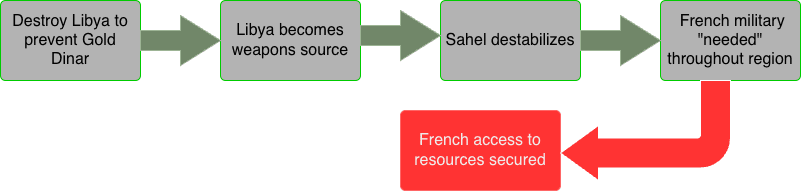
Timing & Outcomes
- 2011: Gaddafi killed, Libya destroyed
- -> 2012: Mali destabilizes
- -> 2012: Tuareg rebellion in Mali
- -> Shortly after: Islamist groups take over northern Mali
- 2013: France intervenes with Operation Serval
- 2013: French troops enter Mali
- 2014: Region-wide Operation Barkhane begins
Problem-reaction-solution
France creates instability, then “solves” it with military presence.
Cui Bono? (Who benefits?)
The Business Model of Eternal War
Me: Explain how terrorism is profitable. Who makes money from this?
Respondent: Follow the money from chaos to bank accounts.
Who are the players and how do they profit from this?
Defense Contractors
The major French defense companies—Dassault Aviation, Thales Group, Nexter, and Safran—have built an empire on perpetual conflict. The model is simple: terrorism creates demand for military hardware. African nations buy French weapons to fight terrorism. French military operations require constant equipment replacement. Add in upgrades, maintenance contracts, and training programs, and you have a perpetual revenue stream. France’s defense industry is a €200+ billion sector, with African arms sales representing a growing market. Each terrorist attack justifies more weapons purchases.
Private Military Companies
PMCs like the Russian Wagner Group and various Western security firms profit directly from instability. Mining companies need security, so governments hire PMCs to protect assets. The more chaos, the more security needed, the more contracts flow. Here’s a perfect example: a French company needs to extract uranium in Niger, there’s terrorism in the region, so they hire a PMC to secure the mining site at millions per year. If terrorism ended, so would the contracts. The incentive becomes obvious—maintain just enough instability to justify security, not so much that operations shut down.
Reconstruction and “Development”
The cycle is beautifully cynical. Terrorism destroys infrastructure, international development agencies contract for rebuilding, Western companies win those contracts, infrastructure gets rebuilt, then it’s destroyed again. Repeat indefinitely. Construction firms, engineering companies, and development consultancies—all based in former colonial powers—profit every single time.
The Refugee Industry
Sahel instability creates refugees who flow north toward Europe. European nations then pay billions for “migration management”—contracts for detention centers, border security, deportation operations. Companies profit from processing human misery. The cynicism is staggering: the same nations whose policies destabilized the region now profit from managing the refugees fleeing that destabilization. Then they use the refugee “crisis” to justify more intervention, which creates more instability and more refugees.
Intelligence and Surveillance
Terrorism justifies mass surveillance, which means contracts for intelligence systems, “training” programs for African intelligence agencies, and access to communications data. But the real value isn’t counter-terrorism—it’s economic intelligence on Chinese and Russian competitors, political intelligence on African leaders, and resource discovery and mapping. Counter-terrorism becomes cover for comprehensive intelligence gathering.
The Terrorist Supply Chain
Me: You’re implying terrorists are somehow supplied or created. How would that even work?
Respondent: I’m not saying France directly creates terrorist groups, but the patterns are suspicious.
French weapons regularly show up with terrorist groups. The official explanation is always “captured from military,” but the frequency suggests something more systematic. Weapons get “lost” during transfers to allied forces, and plausible deniability is always maintained.
Then there’s the funding. Ransom payments for hostages fund terrorist operations and recruitment. French companies have paid millions in ransoms. It’s officially discouraged but practically tolerated, because hostages require rescue operations, which means more military presence.
French intelligence is remarkably ineffective at preventing attacks despite massive surveillance and human intelligence networks. Attacks happen with suspicious timing, often when French presence is being questioned politically. Very convenient for justifying continued operations.
And captured terrorists are often released after “deradicalization” programs, many return to terrorism, and the cycle continues. It’s almost like the goal isn’t to eliminate terrorism, but to manage it.
This isn’t new. The CIA funded the mujahideen in Afghanistan, who became Al-Qaeda. The US supported Iraqi fighters who became ISIS leadership. France has supported various groups in former colonies throughout history. Blowback isn’t a bug—it’s a feature that justifies continued presence.
The Convenient Coups
Me: Recent coups in Mali, Burkina Faso, Niger—all expelled French troops. Explain that pattern.
Respondent: This is where it gets interesting and shows the business model adapting.
In Mali (2020-2021), growing anti-French sentiment led to protests against military presence. A coup removed the pro-French government, the new junta expelled French troops in 2022, and invited Russian Wagner Group instead. Terrorism continued, just with a different beneficiary.
Burkina Faso saw two coups in one year (2022), both justified by failure to address terrorism. French troops were asked to leave, Russian influence grew, and violence continued.
Niger’s 2023 coup removed pro-French President Bazoum, the junta demanded French troop withdrawal, France initially refused then was forced out, Russian advisors arrived, and terrorism persisted.
Here’s the obvious question: after years of French “counter-terrorism” operations, billions spent, thousands of troops deployed, the coups are justified by… failure to stop terrorism?
Two possibilities exist
Option 1: French operations genuinely failed despite unlimited resources, intelligence networks, decades of experience, and total air superiority—they just couldn’t stop small terrorist groups.
Option 2: Stopping terrorism was never the goal. The goal was maintaining presence, protecting resource access, preventing Chinese and Russian influence, with terrorism providing the justification. Success would eliminate the reason to stay.
The evidence points toward Option 2. Mining operations are always protected while villages are continuously attacked. French bases are located near resources, not population centers. Terrorism actually increased during French presence. Yet resources kept flowing despite the “instability.”
The Replacement: Wagner and the Russian Model
Me: So Russia’s Wagner Group is replacing France. Are they any better?
Respondent: Wagner is the same business model with a different flag.
Their approach is more brutal with fewer PR concerns. They directly protect mining and resource operations, often getting paid in mining concessions rather than cash. There’s less pretense about “counter-terrorism” and more honesty about being mercenaries. The results? Terrorism continues, human rights violations increase, resources still get extracted, local populations still suffer. Just different masters.
The real lesson is that whether it’s the French military or Russian mercenaries, the business model is the same. Resources get extracted and profits flow out. Instability is maintained at a profitable level. Local populations stay trapped in perpetual conflict. “Counter-terrorism” actually means “secure our assets.”
Here’s the cynical truth: Mali didn’t trade French exploitation for freedom. They traded French exploitation for Russian exploitation. The commodity being fought over isn’t peace or stability—it’s access to resources and the profits from managing chaos.
Who Pays the Price?
Me: While contractors profit and militaries play games, what about actual people?
Respondent: They pay everything while benefiting nothing.
Thousands are killed in terrorist attacks and thousands more in military operations. Civilian casualties get dismissed as “collateral damage,” and each death feeds the narrative justifying more intervention. Millions of refugees flee the violence, refugee camps become permanent settlements, families are destroyed, communities are shattered, and entire generations grow up in conflict zones.
Infrastructure gets destroyed repeatedly, agricultural production is disrupted, trade routes become unsafe, investment is scared away, and poverty deepens while resources continue being extracted. Entire generations are traumatized, education is interrupted, healthcare systems collapse, the social fabric is destroyed, and hopelessness breeds the next generation of recruits.
The cycle is vicious: instability creates poverty, poverty creates a recruitment pool for terrorism, terrorism justifies intervention, intervention creates more instability, resources get extracted throughout, and local populations never benefit.
The Questions We Should Ask
Me: This is overwhelming. How do we even think about this?
Respondent: Ask the uncomfortable questions.
Why does terrorism always emerge where Western resources are located? Not all poor regions have terrorism, but all strategic resource regions do. Correlation or causation?
Why do anti-terrorism operations never end? Afghanistan lasted 20 years and the Taliban won. Iraq has ongoing instability. The Sahel is worsening despite interventions. It’s almost like “winning” isn’t the goal.
Who profits from perpetual conflict? Defense contractors, private military companies, surveillance firms, and former colonial powers maintaining access all profit. Local populations definitely don’t.
What happens when nations reject Western “help”? You get coups in Mali, Burkina Faso, and Niger. You get increased terrorism like in Libya and Mali. You get economic sanctions and diplomatic isolation. It’s almost like refusing help triggers destabilization.
Why are resources always secured while populations aren’t? Mining operations are heavily guarded while rural villages are repeatedly attacked. Priorities reveal the true mission.
The uncomfortable answer: terrorism may not be the problem being solved. It may be the solution being implemented.
Strategic Chaos as Policy
Me: Are you saying powerful nations deliberately create chaos?
Respondent: I’m saying observe the pattern and benefits.
Stable, unified African nations could negotiate better resource contracts, form economic blocs, develop indigenous industries, challenge neo-colonial arrangements, and become competitors rather than suppliers. Unstable, conflict-ridden nations can’t effectively negotiate, remain dependent on outside “help,” sell resources cheap for immediate cash, can’t invest in development because money goes to security, and stay weak and exploitable.
From a purely strategic perspective—morality aside—maintaining low-level instability prevents strong states from emerging, justifies military presence, enables resource extraction at favorable terms, creates markets for weapons and security, prevents Chinese and Russian influence expansion, produces intelligence access, and generates multiple profit streams. And there’s always plausible deniability because it’s never done openly, always under humanitarian or security cover, with complexity obscuring intent and “unintended consequences” as the excuse.
This isn’t speculation. Declassified documents show the CIA destabilizing Congo for resources, the US supporting coups throughout Latin America for corporate access, and the British playing divide-and-rule in colonies to maintain control. It’s the standard imperial playbook: prevent unity, maintain instability.
The Connection to Individual Freedom
Me: How does this relate to consciousness suppression and individual sovereignty?
Respondent: Same mechanism, different scale.
Suppressing nations means keeping them weak through instability, extracting resources while populations suffer, justifying control as “helping them,” eliminating leaders who seek genuine independence, and profiting from their dependency.
Suppressing individuals means keeping them weak through fear and pharmaceutical dependency, extracting wealth through healthcare and consumer systems, justifying control as “treating illness,” marginalizing those who seek genuine consciousness, and profiting from their dependency.
The pattern is always the same: create or maintain the problem, offer a solution that perpetuates dependency, profit from managing rather than solving the problem, eliminate alternatives, label resisters as dangerous, and extract maximum value.
Whether it’s keeping Africa unstable or keeping individuals medicalized, the business model is identical—perpetual problem management generates perpetual profit.
In Part 8, we synthesize everything: how consciousness suppression, neo-colonialism, and terrorism management are branches of the same control tree. And more importantly, how to break free.
Sources
Operation Barkhane Documentation:
- French Ministry of Defense reports on Sahel operations
- Independent analyses of French military effectiveness
- Correlation between troop deployments and resource locations
Defense Industry Profits:
- Annual reports from Dassault, Thales, Nexter
- African arms trade databases (SIPRI)
- Private military contract disclosures
Libya-to-Sahel Weapon Flows:
- UN reports on post-Gaddafi weapon proliferation
- Small Arms Survey data
- Regional security analyses
- “The Shock Doctrine” by Naomi Klein – Disaster capitalism model
- “War Is a Racket” by Smedley Butler – Military industrial complex expose
- “Confessions of an Economic Hit Man” by John Perkins – Similar patterns globally
- “Dirty Wars” by Jeremy Scahill – Modern warfare business model
Documentary:
- “Shadow World” (2016) – Arms industry investigation
- “Why We Fight” (2005) – Military industrial complex